Sunday, March 15th is a date that Operations Manager, Tiffany, and the rest of the WCR staff will not soon forget.
The day started as any other, AM medications were handed out to all the wild cats. Medication rounds are a critical time to assess the health of our wild cats and on Sunday morning, all the cats appeared to be happy and healthy.
How much can change in just a few hours.
During PM medication rounds, 13 year old bengal tiger, Hobbes, was not waiting excitedly with his brother, Calvin. This was extremely unusual as Calvin and Hobbes are normally at the fence jostling good-naturedly for treats.
Tiffany quickly ascertained that Hobbes was in his den box and did not appear to be responsive. After much encouragement, Hobbes finally got to his feet, but it was clear that something was very wrong. Tiffany called Animal Care Director, Natasha to apprise her of Hobbes’s condition. Soon after, Natasha arrived with sanctuary veterinarian Dr. Jacobs to assess the situation. Dr. Jacobs concluded that, due to his symptoms, nystagmus, ataxia, and nausea, along with their rapid onset, Hobbes had likely suffered a vestibular event.
The treatments of choice for vestibular disease are time and supportive medications to help control dizziness and nausea. Animals are often able to make full recoveries and we hoped that Hobbes would do just that.
Unfortunately, Hobbes’s road to recovery would prove to be riddled with obstacles.
Due to dizziness and nausea and the difficulty of administering medications while he was in his den box, it was decided to move him to a crate and into the hospital. Even with supportive meds, however, Hobbes did not show improvement over the next few days. He continued to decline food and the team began to worry that something else might be wrong. On Thursday, March 19th, Hobbes was loaded up and taken to Oregon State University’s Lois Bates Acheson Veterinary Teaching Hospital, ninety minutes away.
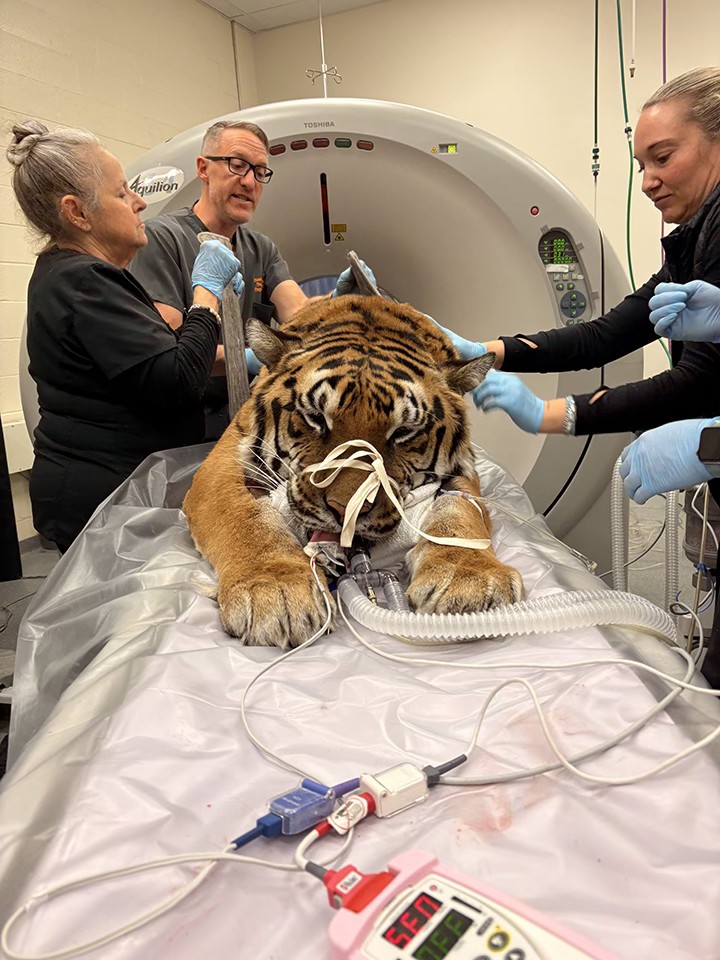
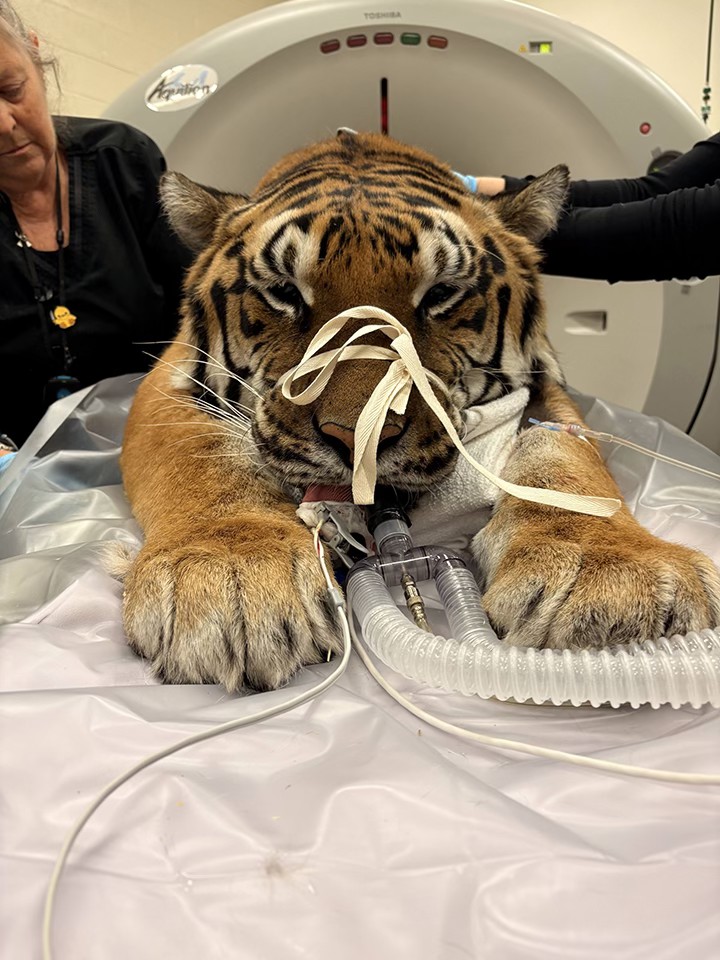
Hobbes was anesthetized and received a full work up including a full body CT scan. Despite exhaustive testing including a cerebral spinal fluid tap, nothing was revealed that would fully explain his symptoms. OSU’s veterinarian team concurred with Hobbes’s original diagnosis of Idiopathic Vestibule Disease (IVD), “idiopathic” indicating that the disease has an unknown cause. IVD is a common neurological disorder in cats and older dogs.
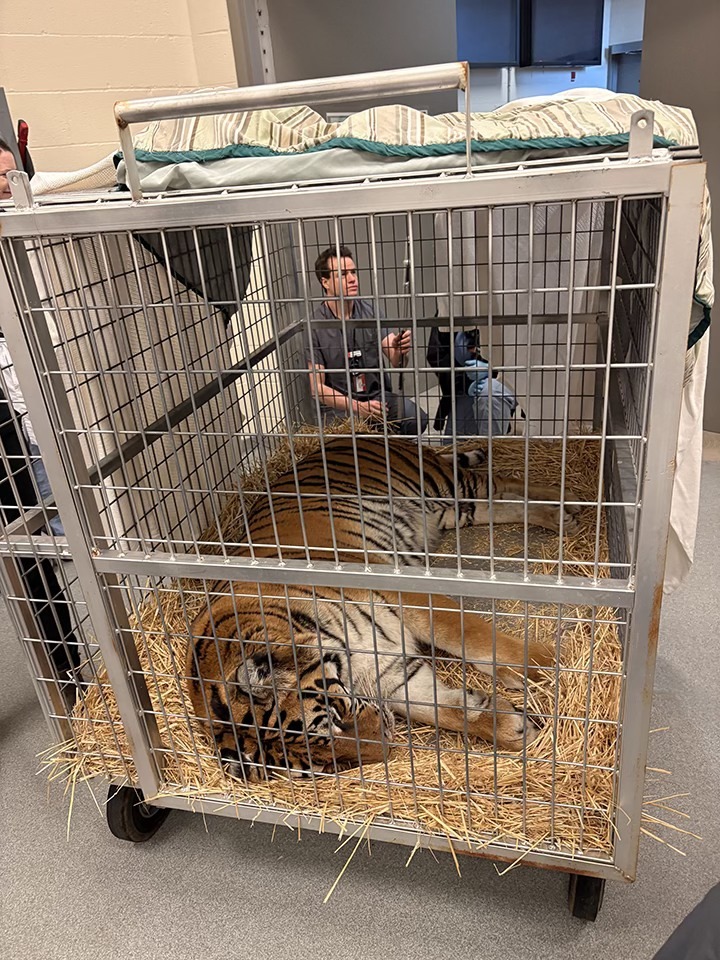
Hobbes returned to the sanctuary and to an uncertain future.
Although the following days were often stressful and fraught with uncertainty, the dedicated WCR animal care and veterinarian teams never gave up on Hobbes and continuously came up with ingenious methods to make sure he received the support and care that he required. Still unsure if Hobbes would recover, the decision was made after a week to move him back out near his brother in the hope that the stimulation of seeing Calvin and being in familiar surroundings would turn the tide. Sure enough, a few days later Hobbes began to show interest in food.
Nearly a month later and you can now find Hobbes frolicking with his brother full-time, eating his regular diet, and enjoying sunny sanctuary days.
We are so thankful to everyone involved in Hobbes’s diagnosis and recovery and to everyone who donated and continues to donate to cover Hobbes’s medical bills as well as those of each and every cat at WildCat Ridge.
Thank you for being here when we need you!
We truly could not do this without you, our supporters and friends.
Recent Posts
-
September 15, 2026
-
April 26, 2026
-
March 8, 2026
-
May 18, 2025
-
March 31, 2025